One World. One Standard. Why Surgical Education and Assessment Must Be Global
- Selvaraj Balasubramani
- Dec 17, 2025
- 3 min read
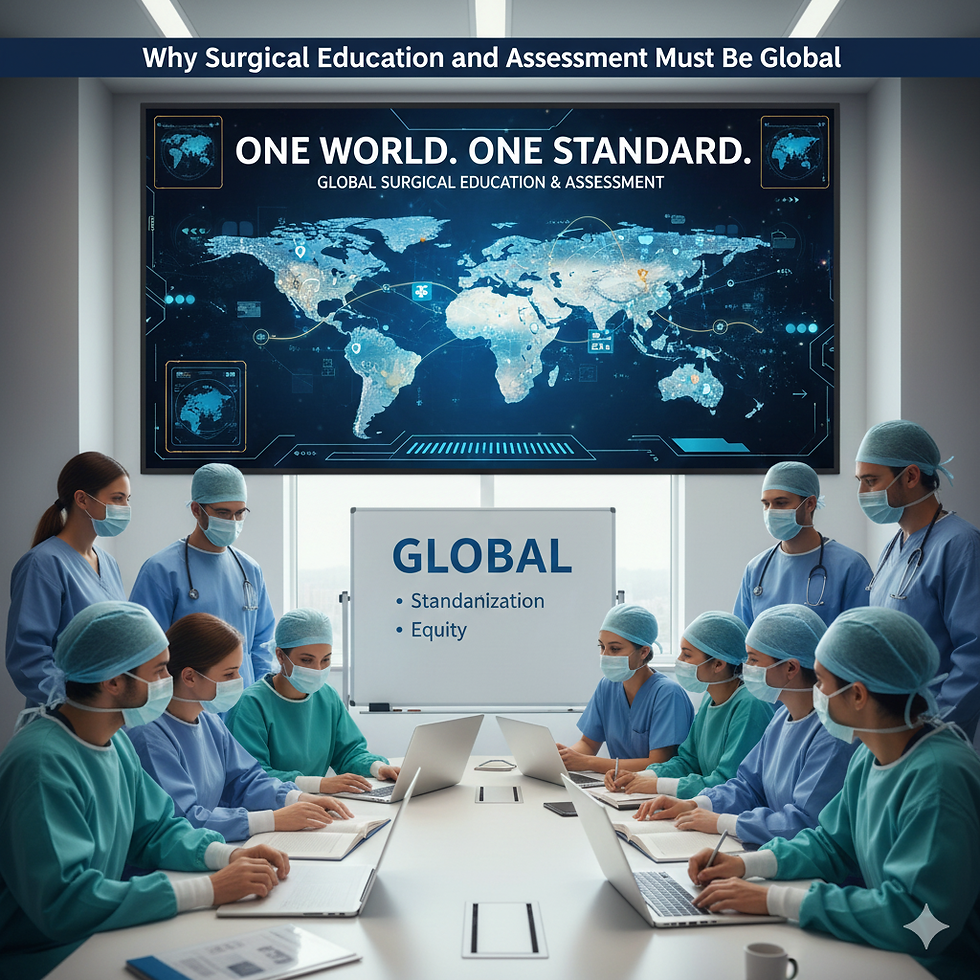
A bleeding patient does not care where the surgeon was trained.
The anatomy is the same. The principles are the same. The responsibility is the same.
Yet, surgical education and assessment still vary wildly based on geography. What qualifies a student as “competent” in one region may be considered insufficient—or excessive—in another. In an interconnected world, this fragmented approach no longer makes sense.
Surgery is universal. Surgical education and assessment should be too.
🧠 The Scalpel Doesn’t Recognize Borders
A gallbladder in London looks the same as one in Lagos, Mumbai, or São Paulo. Shock behaves the same. Sepsis follows the same physiology.
While healthcare systems differ, core surgical thinking does not. History taking, physical examination, decision-making, anatomy, tissue handling, and ethics are universal competencies.
When these fundamentals are taught inconsistently, patient safety suffers—not because of lack of intelligence, but because of lack of standardization.
💬 “Competence should not depend on postal code.”
🎓 The Problem With Region-Bound Teaching Models
Traditional surgical education is often shaped by:
Local exam patterns
Regional resource availability
Institutional traditions
This creates uneven benchmarks for competence. Some trainees are overexposed to theory but underexposed to decision-making. Others gain hands-on experience but lack structured reasoning frameworks.
Neither produces the globally competent surgeon that the future demands.
📊 Global health studies highlight that variability in training standards contributes significantly to disparities in surgical outcomes worldwide.
🔍 Assessment Must Measure Thinking, Not Geography
Examinations should assess:
Clinical reasoning
Prioritisation
Safe decision-making
Ethical judgment
—not rote memory or regional quirks.
A future surgeon should be evaluated on how they think when faced with a problem, not on how closely they mirror a local syllabus.
This is why problem-oriented, case-based assessment is emerging as the most reliable global standard.
💡 A well-designed case transcends borders. A poorly designed exam reinforces them.
🤖 Technology Makes Global Surgical Education Possible
For the first time in history, we have the tools to standardize surgical education at scale.
AI-powered case simulations, virtual patient encounters, structured roleplay, and objective performance analytics allow every learner—anywhere—to be trained and assessed against the same benchmarks.
This is not a theory. This is reality.
At Surgical Educator’s Advanced Online Surgery Masterclass, learners from different regions engage with the same clinical scenarios, make decisions in real time, and receive consistent, unbiased feedback.
Geography disappears. Competence remains.
🩺 Global Does Not Mean Generic
A global curriculum does not ignore local realities—it strengthens fundamentals.
Once universal principles are mastered, surgeons can adapt to local resources, disease patterns, and systems. Without strong foundations, adaptation becomes improvisation—and that is dangerous.
💬 As the World Health Organization emphasizes, safe surgery depends first on trained, competent professionals—not geography.
🧩 The Role of Educators: From Local Trainers to Global Mentors
Surgical teachers today are not just instructors—they are custodians of global standards.
Experience-based teaching, case-driven discussions, and reflective assessment help bridge gaps between regions and generations.
In this model, experience travels—from expert to trainee, across borders, through structured learning platforms.
⚖️ The Philosophy Behind Surgical Educator
The Surgical Educator Advanced Online Surgery Masterclass is built on one simple belief:
A surgeon trained anywhere should be safe everywhere.
By integrating:
Global case-based teaching
AI-powered simulated assessments
Experience-driven instruction
Universal clinical frameworks
The Masterclass prepares learners not just to pass exams—but to practice safely, confidently, and ethically anywhere in the world.
✅ Conclusion: The Future of Surgery Is Global
The operating room is a shared space of human trust. Patients place their lives in our hands—regardless of nationality.
Surgical education must rise to that responsibility.
One world.One patient.One standard.
🌍 Global surgical education is not an aspiration anymore—it is an obligation. And at Surgical Educator, that future is already taking shape.
Link to my first course on Surgical Educator Academy:
Preview 3 chapters and 24 lessons freely as a trailer, and judge the quality & value of the course and make an informed decision.
Comments